
Main page content
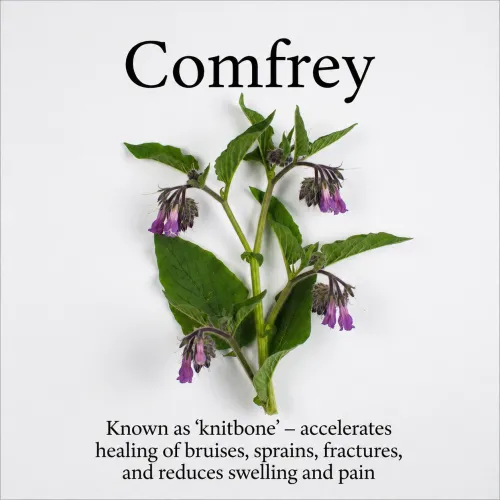
Comfrey (Symphytum officinale) has been cherished for centuries as one of nature’s most remarkable healing plants. Known traditionally as “knitbone” or “boneset,” this powerful herb earned its name from its long history of supporting the body’s natural ability to repair and regenerate tissues, especially bones and muscles.
Key Benefits of Comfrey
- Revered for centuries as “knitbone” — traditionally used to support the healing of broken bones and promote faster bone knitting.
- Remarkable ability to support tissue repair and regeneration.
- Helps calm discomfort and soothe sore muscles and joints.
- Works to reduce the appearance of bruising and ease swelling from sprains and strains.
- Supports the body’s natural recovery process after minor injuries, muscle pulls, or everyday wear.
- Promotes the body’s natural restorative properties and general joint & tissue comfort.
- Rich in allantoin, a compound known to encourage new cell growth and healthy skin regeneration.
- Helps soothe inflamed or irritated skin and supports overall skin comfort and appearance.
Comfrey is best used topically in the form of balms, salves, or poultices for targeted, localized support. This makes it a wonderful addition to any natural first-aid kit for active lifestyles, athletes, gardeners, and anyone who values traditional plant wisdom.
Key Benefits of Comfrey
- Revered for centuries as "knitbone" — traditionally used to support the healing of broken bones, sprains, and fractures through its remarkable tissue-regenerating properties.
- Rich in allantoin, a clinically studied compound that stimulates cell proliferation, accelerates new tissue formation, and supports healthy skin regeneration at the site of injury.
- Contains rosmarinic acid, a potent natural anti-inflammatory that helps calm swelling, ease discomfort, and reduce localized irritation in muscles and joints.
- Helps reduce bruising and swelling from minor sprains, strains, and blunt trauma — making it a go-to herb in traditional natural first-aid care.
- Supports the body's natural recovery process after muscle pulls, overuse injuries, and everyday wear on connective tissue.
- Provides deep soothing relief to sore, stiff, or inflamed joints — particularly valued by athletes, gardeners, and those with active lifestyles.
- Helps calm irritated and inflamed skin, supporting overall skin comfort and a healthier skin appearance when applied topically.
- Promotes connective tissue integrity by supporting collagen synthesis and healthy extracellular matrix repair at the site of application.
Multiple randomized controlled trials have confirmed comfrey root extract's effectiveness as a topical agent. A landmark study by Koll et al. (2004) demonstrated that a comfrey root ointment significantly outperformed placebo in reducing pain and swelling from ankle sprains, while Predel et al. (2005) confirmed superior analgesic effects for muscle pain compared to pharmaceutical diclofenac gel — establishing comfrey as one of the most evidence-backed herbs in natural topical pain care.
Traditional Chinese Medicine (TCM) Perspective
Comfrey's extraordinary ability to accelerate bone healing, consolidate fractures, and regenerate connective tissue resonates deeply with TCM's class of Kidney-tonifying, bone-strengthening, sinew-nourishing herbs. It is functionally most closely related to Xù Duàn (续断) and Gǔ Suì Bǔ (骨碎补) — classical herbs for bone and sinew healing.
- TCM Functional Equivalent: Xu Duan (续断) — Teasel Root; Gu Sui Bu (骨碎补) — Drynaria Rhizome
- Nature & Flavor (functional): Warm; Sweet, slightly Pungent
- Meridians Entered (functional): Kidney, Liver
- Key TCM Actions: Tonifies Kidney Yang, strengthens bones and sinews, promotes healing of fractures and traumatic injuries, generates flesh and repairs tissue, invigorates Blood at the deep tissue level, relieves pain from injury.
The name Gu Sui Bu (骨碎补) literally translates as "mend broken bones" — and modern research confirms that the compounds in this classical TCM herb stimulate osteoblast proliferation and bone matrix formation in ways remarkably similar to comfrey's allantoin and rosmarinic acid mechanisms. Both traditional Chinese bone-healing herbs and comfrey work through the TCM Kidney meridian's governance of bone and marrow — the tissue system responsible for structural integrity throughout the musculoskeletal framework.
Topical comfrey preparations have been studied at 35% comfrey root extract concentration in salve or ointment form. Koll et al. (2004) used a standardized comfrey root extract ointment applied 3–4 times daily to the affected area for up to 8 days, showing significant reduction in pain, swelling, and restricted movement from acute ankle sprains. Predel et al. (2005) confirmed comparable or superior outcomes to diclofenac gel using the same topical protocol for muscle pain. For bruising and minor soft-tissue injury, application of a generous layer 2–3 times daily for 5–7 days is the most well-supported approach.
Comfrey Root Healing Salve — Classic Topical Protocol
- Apply a thin, even layer of comfrey-infused salve or balm directly to the affected area — bruise, sprain, sore muscle, or stiff joint.
- Gently massage in using slow, circular strokes for 30–60 seconds until the salve begins to absorb into the skin.
- Cover loosely with a clean cloth or bandage if desired to keep the area warm and encourage deeper absorption.
- Repeat 2–3 times daily for up to 10 consecutive days on intact, unbroken skin only.
- For ongoing joint or muscle comfort, apply once daily in the morning before activity or once in the evening as part of a restorative wind-down routine.
Research note: Comfrey must NEVER be applied to open wounds, broken skin, or deep puncture wounds, as the compounds that promote cell proliferation can cause surface tissue to close over an unhealed wound. It is strictly for external, topical use on intact skin — internal consumption is not safe and is not recommended under any circumstances.
Before you use this: Comfrey contains pyrrolizidine alkaloids (PAs), which are toxic to the liver and have demonstrated carcinogenic potential when consumed internally — comfrey must never be taken by mouth in any form, including teas, tinctures, or capsules. For topical use, the German Commission E and ESCOP recommend limiting application to no more than 4–6 weeks per year on any single area of intact, unbroken skin; do not apply to open wounds, broken skin, or mucous membranes, and avoid use over large body surface areas. Comfrey is absolutely contraindicated during pregnancy and breastfeeding, and should not be used on children under 12 years of age. Even topical preparations can result in trace PA absorption through the skin, so those with existing liver conditions should avoid use entirely and consult a qualified practitioner before use. The information on this page is for educational purposes only and does not constitute medical advice. Every person's health is unique — before incorporating any herb or botanical into your routine, especially if you are pregnant, nursing, managing a health condition, or taking prescription medications, please consult a qualified integrative health professional.


