
Main page content
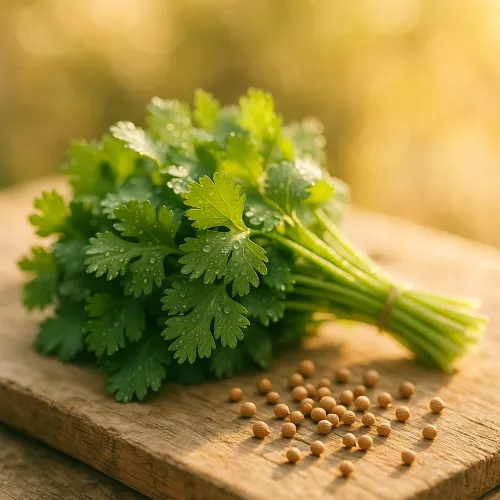
Cilantro — the fresh leaf of Coriandrum sativum, known as coriander when grown out to seed — is one of the oldest culinary and healing herbs on earth, woven through Mediterranean, Middle Eastern, Indian, Chinese, and Latin American traditions for thousands of years. Beyond the kitchen it has earned a modern reputation as a gentle “detox” green, prized in natural-wellness circles for its association with heavy-metal cleansing and for supporting the body’s two great filtering organs, the liver and kidneys. It is also a true nutritional powerhouse — rich in vitamins A, C, and K, folate, and antioxidant plant pigments — and, notably, one of the safest herbs you can reach for.
Key Benefits of Cilantro
- Gentle heavy-metal support — In animal studies, Coriandrum sativum significantly reduced lead deposition in bone and protected the lead-sensitive ALAD enzyme, pointing to a natural, mild chelating action (Aga et al., 2001). Human evidence is still early, so cilantro is best seen as a supportive food rather than a stand-alone treatment.
- Antioxidant-rich — Cilantro leaf is loaded with polyphenols such as quercetin and iso-quercetin and shows strong free-radical scavenging alongside ferrous-ion-chelating activity (Wong & Kitts, 2006) — helping counter the oxidative stress that heavy metals and everyday toxins create.
- Naturally antibacterial — A coriander-leaf compound, (2E)-dodecenal, proved a powerful natural antibacterial — roughly twice as effective as the antibiotic gentamicin against Salmonella in the lab (Kubo et al., 2004) — and cilantro extracts also inhibit E. coli and Bacillus subtilis.
- Liver-protective — A coriander-leaf extract significantly protected rat livers against chemical (CCl4) injury, restoring liver-enzyme markers and tissue health (Pandey et al., 2011) — backing its long traditional use as a liver and digestive tonic.
- Digestive & cooling — Traditionally used to ease bloating and gas, freshen the breath, and “cool” and brighten the whole system.
Traditional Chinese Medicine (TCM) Perspective
In Chinese medicine cilantro is Hú Suī (胡蒰), a warm, pungent, aromatic herb that “releases the exterior” and gently promotes sweating — classically used to bring out and speed the resolution of measles and skin rashes. It moves qi, awakens the appetite, and harmonizes digestion, dispersing stagnant food and cold lodged in the middle burner. Energetically warming and dispersing, it makes an interesting complement to the fresh, cooling, cleansing reputation it carries in the West.
A daily spoonful of fresh cilantro is the simplest way to enjoy its benefits — and pairing it with chlorella turns it into the classic natural metal-support combination. Blend 1 packed cup fresh cilantro, 2 tbsp olive oil, 1 clove garlic, the juice of ½ lemon, a small handful of walnuts or pumpkin seeds, and a pinch of salt — with an optional 1 tsp chlorella powder — until smooth. Stir a spoonful into soups, spread it on toast, or toss it through grains. Use it fresh and a little daily, rather than in large medicinal amounts.
Before you use this: Cilantro is a food and is remarkably safe — toxicity studies found no harmful effects even at doses far beyond what anyone would eat (Pandey et al., 2011). A small number of people have a genuine cilantro allergy, or perceive a harmless “soapy” taste (a normal genetic trait). Its heavy-metal benefits are shown mainly in animal research; if you have a diagnosed metal toxicity, work with a qualified clinician and proper testing rather than relying on cilantro alone, and introduce any detox routine gradually. These statements have not been evaluated by the FDA, and cilantro is not intended to diagnose, treat, cure, or prevent any disease.


