
Main page content
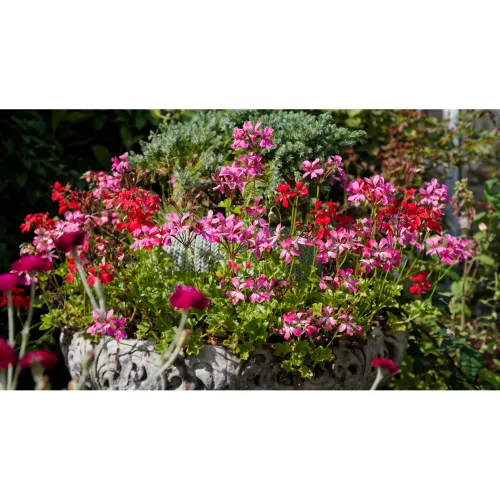
Geranium (Pelargonium graveolens, P. roseum) essential oil is one of the most versatile and beloved ingredients in natural skincare and aromatherapy. Steam-distilled from the leaves and stems of the rose-scented geranium plant of African origin, it combines a beautiful rose-like floral fragrance with a genuinely broad therapeutic profile — balancing, anti-inflammatory, antimicrobial, and deeply supportive of both skin and emotional wellbeing.
Key Benefits of Geranium
- Rich in citronellol, geraniol, and linalool — aromatic compounds with documented anti-inflammatory, antibacterial, and mood-regulating properties. (PubMed reference)
- Uniquely balancing for all skin types — regulates sebum production (helpful for both oily and dry skin) and supports the skin's natural equilibrium.
- Naturally astringent and toning — helps tighten pores, reduce the appearance of blemishes, and support a clear, even complexion.
- Demonstrated anti-inflammatory activity topically — soothes redness, irritation, and reactive skin while supporting wound healing and skin regeneration.
- In aromatherapy, geranium is considered the premier emotional balancer — used for hormonal fluctuations, anxiety, emotional overwhelm, and the need for equilibrium and peace.
- A natural insect repellent — its citronellol content makes it effective against mosquitoes and flying insects when used in body care formulations.
- Its beautiful rose-like floral fragrance — softer and more herbal than rose itself — makes it a prized alternative to rose oil in natural perfumery and skincare.
Geranium is the botanical embodiment of balance — balancing skin, balancing emotion, balancing extremes. Its blend of real skin-supportive function and beautiful floral scent makes it one of the most complete and universally beloved ingredients in natural body care.
Traditional Chinese Medicine (TCM) Perspective
Geranium (Tiān Zhú Kuí, 天竺葵) is used in Chinese herbal medicine to stop bleeding, move Blood, and benefit the skin. Rose geranium in particular resonates with TCM's principle of regulating the Liver and harmonizing Qi and Blood in the emotional and hormonal sphere.
- Chinese Name: Tian Zhu Kui (天竺葵) — Geranium
- Nature & Flavor: Neutral; Bitter, slightly Pungent
- Meridians Entered: Liver, Kidney
- Key TCM Actions: Stops bleeding, invigorates Blood and dispels stasis, astringes, benefits the Kidney, balances hormonal fluctuations through Liver-Qi regulation, relieves skin inflammation.
Geranium's ability to balance sebum production, regulate hormonal skin responses, and reduce inflammation reflects its TCM action on the Liver meridian — the organ system responsible in TCM for regulating the smooth flow of Qi and Blood throughout the body, including the hormonal cycles. Its rosy-herbal scent is emotionally centering, addressing the Liver Qi stagnation that in TCM underlies mood swings, irritability, and anxiety.
Geranium essential oil is used topically at a standard dilution of 1–3% in a carrier oil (roughly 6–18 drops per 30 ml carrier). For pain-relief and anti-inflammatory applications, Boukhatem et al. (2013) documented significant analgesic and anti-inflammatory activity from Pelargonium graveolens EO at topical concentrations, with 2% dilution consistently cited as both effective and well-tolerated for skin application. For aromatherapeutic and emotional-balancing use, 3–5 drops diffused in a cold-air diffuser for 30–60 minutes is the standard aromatherapy protocol.
Geranium Balancing Botanical Body Oil
- Measure 30 ml of a light carrier oil — jojoba, sweet almond, or fractionated coconut oil are ideal — into a clean amber glass bottle.
- Add 12 drops (2%) geranium essential oil (Pelargonium graveolens). For deeper emotional support or a more pronounced floral scent, increase to 18 drops (3%).
- Cap and roll gently between your palms to blend. Apply a small amount to pulse points, the inner wrists, or directly to areas of skin inflammation, muscle tension, or discomfort — massaging in slow circular motions.
- For hormonal or emotional balancing use, apply to the lower abdomen and the back of the neck during times of stress, mood fluctuation, or hormonal transition.
- Alternatively, add 4–5 drops neat to a cold-air diffuser filled with water and run for 30–45 minutes in the evening to support emotional equilibrium and calm the nervous system.
Research note: Geranium essential oil must always be diluted before skin application — undiluted (neat) use can cause sensitisation. A patch test on the inner forearm 24 hours before broader use is strongly recommended. Geranium is NOT equivalent to rose oil and cannot substitute for it medicinally, though it shares a similar aromatic and therapeutic profile at a fraction of the cost.
Before you use this: Geranium (Pelargonium graveolens) essential oil should always be diluted to 1–3% in a carrier oil before skin application — undiluted use may cause contact sensitisation, especially on sensitive or damaged skin; always perform a patch test 24 hours before full application. Geranium EO has demonstrated hormonal-modulating activity and should be used with caution during pregnancy and breastfeeding, and by anyone with oestrogen-sensitive conditions. Individuals with known sensitivities to plants in the Geraniaceae family should avoid use. The information on this page is for educational purposes only and does not constitute medical advice. Every person's health is unique — before incorporating any herb or botanical into your routine, especially if you are pregnant, nursing, managing a health condition, or taking prescription medications, please consult a qualified integrative health professional.


